

If you’ve ever stood under a trickle of a shower and turned in circles just to get wet, you know how frustrating low water pressure can be. When the problem is your incoming water supply and not your pipes, a water pressure booster pump is often the fix. In this guide, you’ll learn how booster pumps work, how to tell if you actually need one, how to size one for your home and which pumps we recommend.
Quick answer: A water pressure booster pump is installed on your main water line and adds pressure to the water coming into your home. It’s the right fix when your incoming pressure is low all the time (usually under 40 psi). Before you buy one, rule out a misadjusted pressure regulator, clogged fixtures and old, corroded pipes. To size a pump, figure out how many gallons per minute (GPM) your home uses at once and how many psi of boost you need.
What is a water booster pump?A booster pump is a pump that increases low water pressure and flow. It takes the water already coming into your home, from the city, a well or a storage tank, and gives it the extra push it needs to reach every faucet and shower at a comfortable pressure.
What causes low water pressure?Low water pressure can start inside or outside your home. Some causes need a booster pump. Others need a simple fix.
Causes a booster pump can fix
- Low city water pressure. Some neighborhoods, especially those at the end of a supply line or on higher ground, simply get low pressure from the water utility.
- Elevation and height. Water loses about 1 psi for every 2.3 feet it climbs, so upper floors and homes uphill from the water source often have weak pressure.
- Long distances. Water that travels a long way through small pipes loses pressure along the way.
- Water from a storage tank. Water stored in a tank (like rainwater or a low-yield well’s holding tank) has no pressure of its own and needs a pump to get into the house.
- Added treatment equipment. Whole-house filters and other treatment systems can take a few psi off your pressure.
Rule these out before you buy a booster pump
- A misadjusted or failing pressure regulator. Many homes on city water have a pressure-reducing valve (PRV) where the main line enters. If it’s set too low or failing, adjusting or replacing it is a much cheaper fix. Learn how to find and adjust your PRV.
- Clogged aerators and showerheads. If only one or two fixtures are weak, clean their aerators and showerheads first.
- Old, corroded pipes. Galvanized steel pipes can close up with rust over time. A booster pump won’t fix a pipe that’s nearly blocked.
- A partly closed main valve after recent plumbing work.
- A well system set too low. If you’re on a well, you may just need to raise your pressure switch setting. See how to adjust a well pressure switch.
Not sure where your pressure stands? Screw a pressure gauge onto an outdoor hose bib. Most homes do best between 40 and 60 psi.
Learn more: How to increase water pressure in your shower: 8 fixes
How does a booster pump work?Most home booster pumps are centrifugal pumps. A motor spins one or more impellers, which fling water outward and push it out of the pump at a higher pressure than it came in. A built-in pressure or flow sensor tells the pump when to turn on (when you open a faucet) and when to shut off (when you close it).
What are the parts of a booster pump?
Most water booster pumps share the same core parts:
- Motor
- Impeller(s)
- Inlet and outlet
- Pressure or flow sensor and controller
- On many models, a small built-in pressure tank
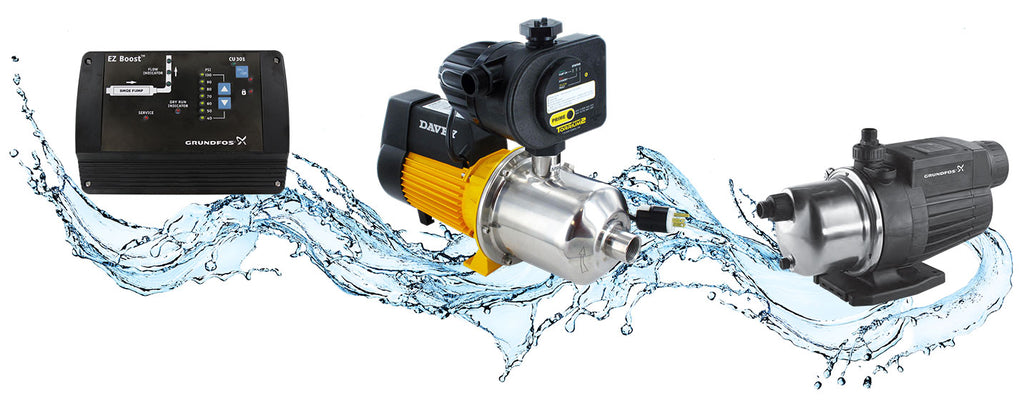
The Davey pump pictured below has a built-in controller that senses pressure and flow to manage the pump.

Yes, but there’s a trade-off: the more pressure a pump has to add, the less water it can move. Think of putting your thumb over a garden hose. The water comes out harder, but less of it comes out. Every booster pump has a performance curve that shows how much flow (GPM) it can deliver at each pressure, so check it against what your home needs.
Types of booster pumpsSingle-stage vs. multistage
Single-stage pumps use one impeller. They’re compact and move a lot of water, but add less pressure. Multistage pumps stack several impellers to build higher pressure, which helps with multi-story homes and long runs.
Standard vs. constant-pressure
A standard booster pump runs at one speed and switches on and off as you use water, so pressure can rise and dip a bit. A constant-pressure (variable-speed) pump, like the Grundfos Scala2, speeds up or slows down to match how much water you’re using. Pressure stays steady even when two showers are running, but these pumps cost more.
How are booster pumps used?Booster pumps are used in homes and commercial buildings to raise low city pressure, push water to upper floors and move water out of storage tanks. A hotel, for example, needs large booster pumps to get water to the top floor.
A booster pump also re-pressurizes water from a storage tank. In a rainwater harvesting system, rain collects in a tank, and a booster pump sends it into the house to flush toilets or run the washing machine.
Learn more: How to conserve rainwater at home with a rainwater harvesting system
Booster pumps for low-yield wells
If your well can’t produce water as fast as your household uses it, a common setup is to let the well slowly fill a large storage tank, then use a booster pump to pressurize water from that tank for the house.
Learn more: What are the parts of a well water system?
Booster pump with a pressure tank
Adding a small pressure tank after the booster pump stores a little pressurized water, so the pump doesn’t have to start every time someone turns on a faucet for a few seconds. Fewer starts mean less wear on the pump and smoother pressure. Larger tanks hold more water between cycles and cut pump starts even more.
To choose the right size, you need two numbers: how much water you use at once (GPM) and how much pressure you need to add (psi).
Step 1: Estimate your flow rate (GPM)
Add up the fixtures that are likely to run at the same time. Typical flow rates:
| Fixture | Typical flow rate |
|---|---|
| Shower | 2 to 2.5 GPM |
| Kitchen faucet | 1.5 to 2.2 GPM |
| Bathroom faucet | 1 to 1.5 GPM |
| Washing machine | 2 to 3 GPM |
| Dishwasher | 1.5 to 2 GPM |
| Outdoor hose | 5 to 10 GPM |
For example, two showers and a dishwasher running together need about 6 to 7 GPM. Many 1- to 2-bathroom homes are well served by a pump in the 10 to 15 GPM range. Larger homes, or homes that run irrigation from the same pump, need more.
Learn more: How to calculate flow rate
Step 2: Figure out the boost you need (psi)
Subtract your current water pressure from the pressure you want. If your gauge reads 30 psi and you want 55 psi, you need about 25 psi of boost at your flow rate. If you’re pushing water to upper floors, add about 1 psi for every 2.3 feet of height.
Step 3: Check the pump curve
Look at the pump’s performance curve or spec sheet and confirm it can deliver your GPM at the boost you need. Also check the voltage: some pumps plug into a standard 120V outlet, while larger pumps need 240V.
Shopping for a pump? Browse all water pressure booster pumps.
Tips for installing a booster pumpWhere to install a booster pump
For whole-house pressure, install the booster pump on the main water line after it enters your home, where you can reach it for service and it’s protected from freezing. For a storage tank, install it between the tank and the house. When installing a booster pump:
- Add a bypass. A bypass lets you isolate the pump for service or if it fails, while still getting water into the house.
- Check with your water utility. Some utilities have rules for pumps connected to the city main and may require a backflow preventer.
- Don’t overdo the pressure. Keep your home between 40 and 60 psi. Anything over 80 psi can damage pipes, fittings and appliances.
- Test for leaks first. A leak in the house can make a booster pump cycle on and off. If the pump keeps cycling with every faucet closed, isolate it and look for a leak.
- Plan the power. Make sure you have the right outlet (120V or 240V) near the pump.
How to keep your booster pump quiet
Pump vibration travels easily through rigid pipe, especially copper. Instead of connecting the pump directly to rigid lines, use flexible connectors on the inlet and outlet, and mount the pump on a solid, level surface. Installing it in a basement, garage or utility room instead of next to a bedroom helps too.
Best water pressure booster pumpsBest booster pump for small homes – Davey BT14-45
The Davey BT14-45 is a good fit for small two-story and long one-story homes. It delivers a nominal flow of 14 GPM and up to 60 psi of boost from a quiet multistage pump. It runs on standard 120V power and includes Davey’s Torrium2 controller, which protects the pump if problems arise. It comes with a 3-year warranty.
Best booster pump for large homes – Davey BT30-30
The Davey BT30-30 is built for bigger homes that need more water at once. It has a nominal flow of 30 GPM and up to 50 psi of boost from a compact single-impeller design. Its Torrium2 controller adapts to changing conditions and protects the pump if problems arise. Note that it runs on 240V power. It comes with a 3-year warranty.
Best constant-pressure booster pump – Grundfos Scala2 3-45
The Grundfos Scala2 3-45 is a variable-speed pump that adjusts to keep your pressure steady, even when several fixtures are running. It’s very quiet (about 47 decibels, around the level of light rainfall) and has a built-in screen, intelligent controls and dry-run protection that shuts the pump off if no water is available. It’s a great all-around choice for homes and irrigation, and it comes in 115V and 230V versions.
Best smart booster pump – Grundfos Scala1 3-45
The Grundfos Scala1 3-45 is a fully integrated, self-priming pump for homes and small commercial uses. Built-in Bluetooth lets you monitor and adjust the pump from the Grundfos GO app. It works indoors or outdoors and runs at about 55 decibels.
Booster pump FAQsWill a booster pump help a well system?
Sometimes. If your well pump and pressure switch are working but pressure is still low, first try raising your pressure switch setting. A booster pump makes the most sense for low-yield wells that fill a storage tank, or for getting water to a building far from the well.
How much does a water pressure booster pump cost?
Most whole-house booster pumps for homes cost a few hundred to around a thousand dollars, plus installation. Constant-pressure models cost more than standard ones.
Can a booster pump make water pressure too high?
Yes. Choose a pump sized for the boost you actually need, and check your pressure with a gauge after installation. Keep your home between 40 and 60 psi.
If you have any additional questions, please do not hesitate to contact us.


Comments
Great and informing article
Hi thanks for the information 🙏🏼
The tips for installing the booster are going to come in handy!
Thanks for sharing your thoughts about booster pump. You have explained very well how booster pump works.
thank you for sharing your article, this article gives clear information about how does booster pump works and explains the components of booster water pumps.
Nicely explained all about water booster pump. Thanks for the information.
Great Article! Thanks for sharing this useful information.
The outlet of the submersible pump is 25mm
I have low pressure in my 1 bed apartment on the 1st floor. Will installing a pump to the water main increase pressure in the entire block or will it be possible to only increase pressure for 1 apartment which shares a water mains with a block
very great article. home water pump so much kind. it based on what the user need. the most important is energy saving and efficiency. thank you for sharing zerogas.nl
Great question, Lorraine! Pressure pumps are designed to always be ‘on’ and are actuated by demand (opening a faucet or flushing a toilet) to provide flow and pressure.